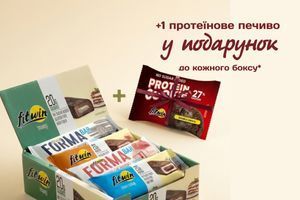
When people hear the phrase “protein cookies,” they often expect that they will be just ordinary cookies with a trendy inscription on the package. But in fact, the difference is much deeper. Protein cookies are created not only for the sake of dessert taste, but also so that they give the body more protein, are a convenient and healthy snack and fit better into the active rhythm of life. The FitWin line includes both glazed and unglazed sugar-free options, in a 40 g format, with a protein content of 25–27%.
How are protein cookies different from ordinary ones?
Ordinary cookies are usually perceived as desserts: sweet taste, soft or crispy texture, pleasure here and now. Protein cookies have a different task. They should not only taste good, but also be more functional: contain a tangible share of protein, dietary fiber and a convenient format for snacking throughout the day. That is why its recipe is built differently - with an emphasis not only on "delicacy", but also on nutritional value. In FitWin, this is visible even in the composition: the products use mixtures of milk proteins, dietary fiber, oat bran and sweeteners instead of the classic emphasis on sugar.
Advantage #1: more protein in each serving
The main advantage of protein cookies is protein. For example, FitWin cookies claim 25–27 g of protein per 100 g, which is about 10–11 g of protein in one cookie weighing 40 g. This is no longer just "something for coffee", but a snack that has real nutritional value and can be appropriate after a workout, between work tasks or on the go.
Advantage #2: sugar-free, but without losing pleasure
Another important difference is the absence of sugar in the line. On the FitWin page, all protein cookie items are labeled as “sugar-free,” and the ingredients of individual products include sweeteners, including maltitol and steviol glycosides from stevia. This allows you to maintain a sweet taste, but build the product according to a different logic than a classic dessert. Simply put: the idea here is not to “hit” the receptors with maximum sweetness, but to make the taste pleasant, balanced, and more everyday.
Advantage #3: A more satisfying and practical snack
FitWin protein cookies also contain dietary fiber: in the items under consideration, it is about 12–13 g per 100 g, or approximately 4.7–5.2 g per 40 g serving. Together with protein, this forms a more “practical” snack format than classic cookies. It is convenient when there is no time for a full meal, but you want something tasty that is not perceived as a random dessert. And such a snack also gives a feeling of satiety for a longer time.
Why does the taste of protein cookies differ?
And here is the most interesting thing. Protein cookies really taste different than regular ones. But this is not a drawback, but a consequence of a completely different recipe task. When the product has a significant proportion of protein, dietary fiber, sweeteners instead of sugar and a different balance of fats and dry matter, the taste becomes less “confectionery-like” and more multi-layered. It can be perceived as less sharp in sweetness, softer, deeper or even more adult. These are no longer cookies in the style of “sugar, butter, flour - and go”, but a different class of product.
Why does the texture feel different too?
The texture of protein cookies is also different. And this is logical: the composition works differently. FitWin's recipes include a mixture of milk proteins, bran, polydextrose, natural ingredients such as orange, ginger, blueberries or currants, as well as two formats - glazed and unglazed. Because of this, the cookies can be perceived as denser, more saturated, less "empty" in feel. That is, the taste and texture here are created not only for instant sweetness, but for a more complete food experience.
Not a "copy of regular cookies", but a separate product
It is best to perceive protein cookies not as a one-to-one replacement for regular cookies, but as a separate category. They are created for people who want to combine taste and benefits without unnecessary compromises. That is why they may have less "classic confectionery" sweetness, but more nutrition, satiety and thoughtfulness. And when you look at it from this angle, the difference in taste becomes not a minus, but an advantage.
Conclusion
Protein cookies differ from regular cookies in that they perform several tasks at once: they give a pleasant taste, contain more protein, have dietary fiber, do not contain sugar in the FitWin line and remain a convenient snack format for every day. And a different taste is a natural result of a different recipe and a different approach to the product. So if regular cookies are just a dessert, then protein cookies are a dessert with character, benefits and more serious intentions. Almost like cookies that have gone one extra step in life and now read the composition, not just the label.